

The Internet Is Freaking Out About Post-GLP-1 Weight Regain
And honestly, this should not be surprising 🫠

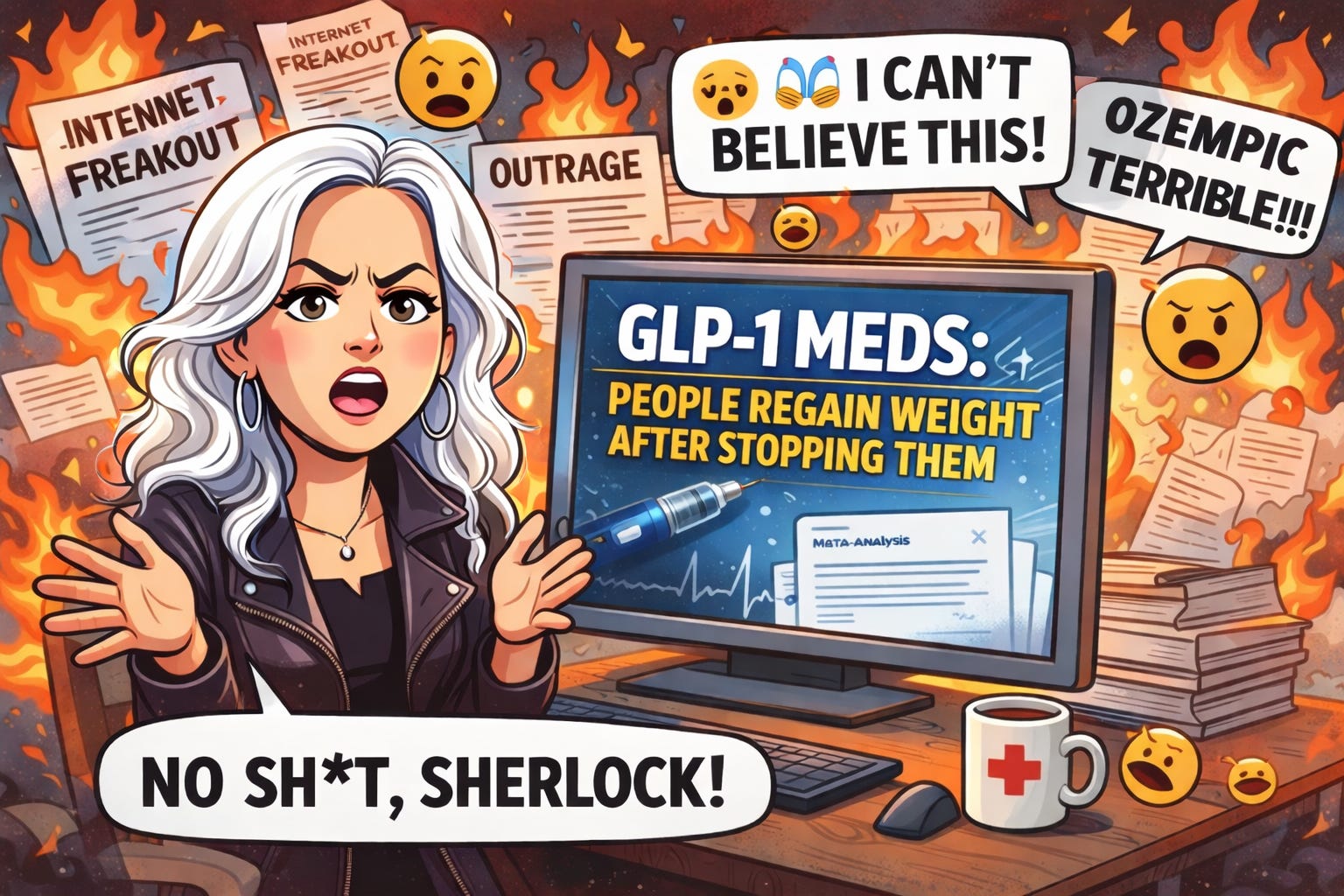
A new paper published in the British Medical Journal lit up social media recently. Headlines everywhere screamed some version of: “People regain weight after stopping GLP-1 drugs.”
Cue outrage. Cue dunking on Ozempic. Cue victory laps from people who already hated these medications.
Here’s the problem. None of this is new. And none of it is shocking.
That’s exactly why I recorded this episode of The Dr. Tyna Show.
What the Study Actually Looked At
The paper is titled Weight Regain After Cessation of Medication for Weight Loss Management. It is a large systematic review and meta-analysis that pooled data from 37 studies, over 9,000 participants, and multiple generations of weight-loss drugs, including GLP-1s and dual incretins.
What did they find?
People regained weight after stopping the drug.
Blood sugar, lipids, biomarkers and blood pressure drifted back toward baseline.
The stronger the drug and the faster the weight loss, the faster the rebound.
If that sounds familiar, it should.
The Part Everyone Is Missing
Here’s a fun game I call “No 💩 Sherlock”.
If someone takes blood pressure medication and changes nothing else, what happens when they stop?
Their blood pressure goes back up.
Same with statins. Same with insulin. Same with every chronic disease managed with medication alone.
Most of these chronic diseases have a strong lifestyle component and at the end of the day if the lifestyle is not changed then the disease process returns full force when the medication is discontinued. No 💩 Sherlock, right?
GLP-1s at standard doses are not magic. They do not CURE obesity. They suppress signaling in a broken system. When you remove the signal without fixing the system, the system reverts.
That’s physiology, not failure.
What’s driving me nuts is watching people pretend this study somehow “exposes” GLP-1s as a scam. It doesn’t. It exposes how deeply misunderstood the disease process of obesity still is.
Why This Matters More Than the Headlines
The study quietly showed something more important.
People who combined behavioral and lifestyle intervention regained weight more slowly than those who relied on medication alone.
That tells you everything you need to know.
Weight loss is not one lever.
Obesity is not only a willpower issue.
And aggressive monotherapy creates rebound risk.
If someone loses a lot of weight quickly without protecting muscle, supporting gut motility, addressing hormones, and building metabolic resilience, the body will fight back.
Listen to the Full Episode
If you’re already forming an opinion, pause and listen to the full episode first.
I break down the study, explain why the rebound happens, discuss the genetic and epigenetic realities of obesity as a disease (and why lifestyle matters a LOT here) and talk about what to actually pay attention to if you want sustainable results.
If you want GLP1 nuance instead of noise, this one’s for you.
YES. I *always* appreciate your nuanced + foundational approach, Dr Tyna! *timeless* wisdom 🍵